API and data
An API and everything around your data, inside Postgres
Every resource you describe gets a REST API and a typed client, and the plumbing an admin needs: events, webhooks, jobs, email and files. It all runs on your own Postgres, without an extra queue service.
Early accessSign up with GitHub or email. Your first app is live in a few minutes. Plans from €0.99 a month.
Or self-host it for freeREST API
Routes for every resource you describe
- GET /api/v1/{resource}
- A list, with a filter, an order and pages of 50, up to 500.
- POST /api/v1/{resource}:search
- The same list, with a JSON body for long filters.
- GET · POST · PATCH · DELETE
- One record. An update needs the record’s current ETag.
- :facets · :series · :histogram
- Counts per value, counts over time and histograms, for filters and charts.
- :map · :seek
- The records in a map’s view, and the page at any row position.
- :upload · :reveal · :undelete
- Files, sensitive fields, and soft-deleted records brought back.
- POST /api/v1:batchWrite
- Up to 500 writes across resources, in one transaction.
# Print a token for a user, from your project
npx protobase token [email protected]
# Repairs that are ready but not paid, newest first
curl --get https://shop.example.com/api/v1/repairs \
-H "Authorization: Bearer $TOKEN" \
--data-urlencode 'filter=status = "ready" AND paid = false' \
--data-urlencode 'order_by=booked_on desc'- Google’s API design guides: AIPs 131 to 136, 158 and 160, with their rules for ordering, ETags, soft delete and undelete.
- Errors as RFC 9457 problem details, with stable names you can match on.
- OpenAPI 3.1 at
/api/openapi.jsonand an interactive reference at/api/docs, both showing only what the caller may use. - Lists return the names of related records and up to 10 photos per record in the same request.
- Web APIs only, so the server runs on Node and on Workers.
Filters
One filter language, in the address and in the API
- Filters are AIP-160 text, parsed by aip-parsers, the maintainer’s own open-source library.
- Functions for lists of values, search, similarity, regular expressions, empty values and relative dates such as
now() - 7d. - A filter error points at the part of the text that is wrong, with a hint.
Typed client
@protobase/client
- Typed calls for lists, records, search, aggregates, maps, sensitive fields, files with upload progress, and your API functions.
- Record types follow from the resource description, and filters can be built with a typed helper.
Safe by default
Fast and correct on real data
Transactions
Every request runs in a transaction with a time limit, and reads run read-only.
Big tables
A query that would scan a large table is refused, with the index to add. Counts on big tables come from the planner.
Writes
Every write runs in one transaction with a row lock, the access check and your write hooks.
Events and webhooks
Every change, wherever it came from
Events
Postgres triggers write each change to an outbox in the same transaction, so writes from psql, other services and cron jobs count too. API writes arrive in milliseconds, others within two seconds.
Webhooks
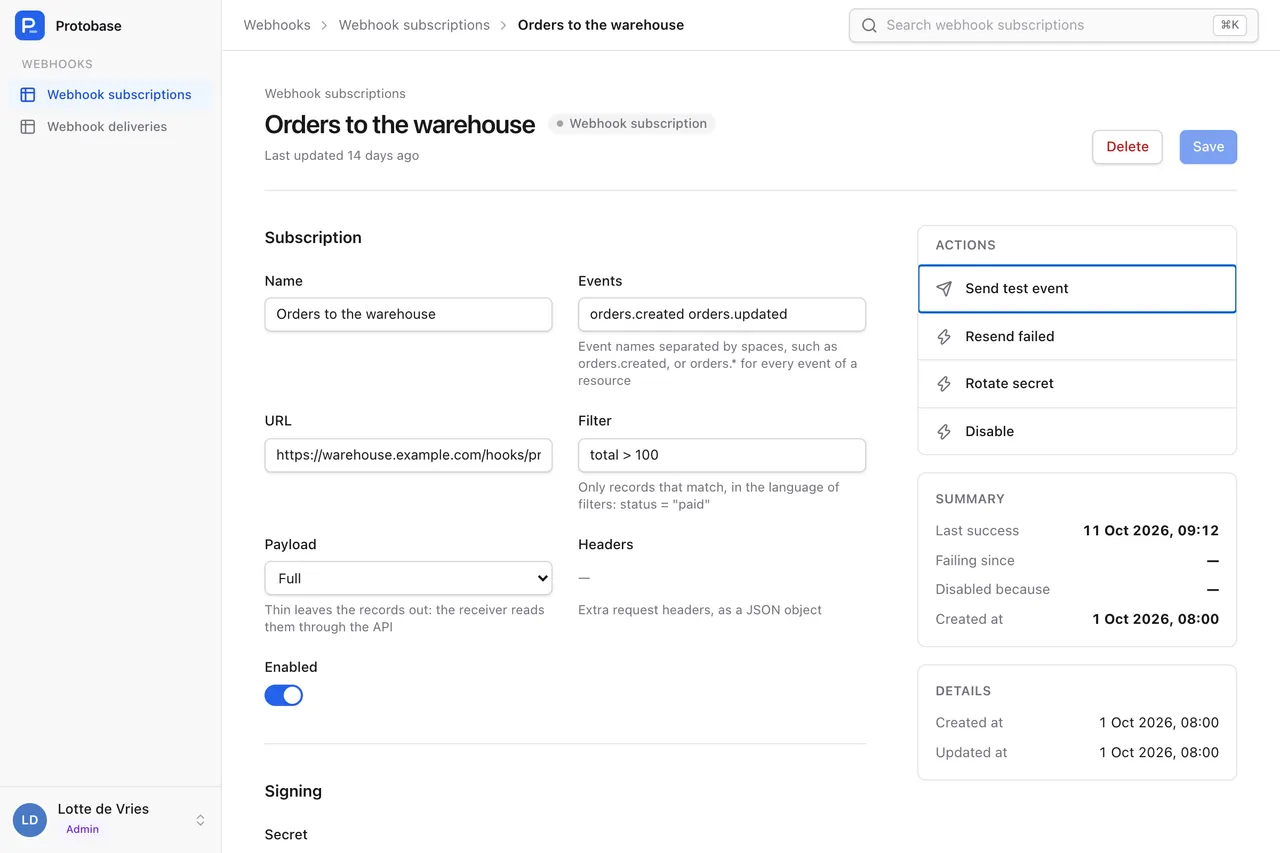
Declared in code or created in the admin app. Signed per the Standard Webhooks spec and retried 10 times over about three days, honouring
Retry-After.Webhook tools
Ordered delivery when you need it, full or thin payloads, your own body shape, a test event, resending failed ones and rotating secrets. Deliveries are kept for 30 days.
Jobs and email
Background work, kept in your database
Jobs
pg-boss in your own Postgres, enqueued in the same transaction as your write, even from SQL. Retries with backoff, timeouts, priorities and keys that prevent duplicates.
Schedules
Cron schedules with time zones that handle daylight saving; missed runs collapse into one. Failed jobs get a page with Retry and Delete.
Email
One SMTP server for sign-in mail and your own. Templates are React Email components, sent from jobs, write hooks or API functions.
Files and images
Uploads and images, handled
- A file field stores a reference in a plain text column; there are no extra tables.
- Files go to local disk or any S3-compatible bucket (the S3 provider needs Bun), with streaming uploads, signed links for private files and a year of caching for public ones.
- Images get resized WebP, AVIF, JPEG and PNG versions and a small placeholder shown while they load. Orientation is fixed and metadata removed.
- Replaced files are deleted on a schedule, a day later by default.
Your own endpoints
When you need code of your own
API functions
One file per endpoint in
functions/, a web-standard handler or a Hono app. It gets the session, records that follow the caller’s access, and the database for privileged work.Signed webhooks in
Helpers check the signatures of incoming webhooks, both HMAC ones and Standard Webhooks, and validate bodies with Zod, Valibot or ArkType.
Remote resources
One Protobase app can show another app’s resources as its own. The browser calls the other app directly with a short-lived token; there is no proxy.
Start with the database you have
Install the CLI, describe your tables and run the admin on your own machine. Protobase never migrates your database by itself.
Your back office, live in a few minutes
Sign up with GitHub or email, pick a starting point, and ask the assistant for what you need.
Start in the cloudEarly access Plans from €0.99 a month.